Every coach says the same things.
“Press into your highback.” “Use torsion.” “Get on your front foot.”
They’re not wrong. For them, it works.
But here’s the problem nobody talks about: every body is different.
Different bone structure. Different joint mobility. Different muscle fiber distribution. Different movement patterns.
The same cue can fix one rider and wreck another.
- The Problem Nobody Diagnoses
- Why Individual Differences Matter More Than Technique
- What the Muscle Soreness Was Telling Me
- What I Actually Did Differently
- Why Contact Works Better Than Conscious Torsion
- Why “Use Torsion” Works for Some Riders and Not Others
- The Role of Difficult Snow Conditions
- Individual Sport, Individual Problem
- One Thing to Try
- What This Is Not
- Related
The Problem Nobody Diagnoses
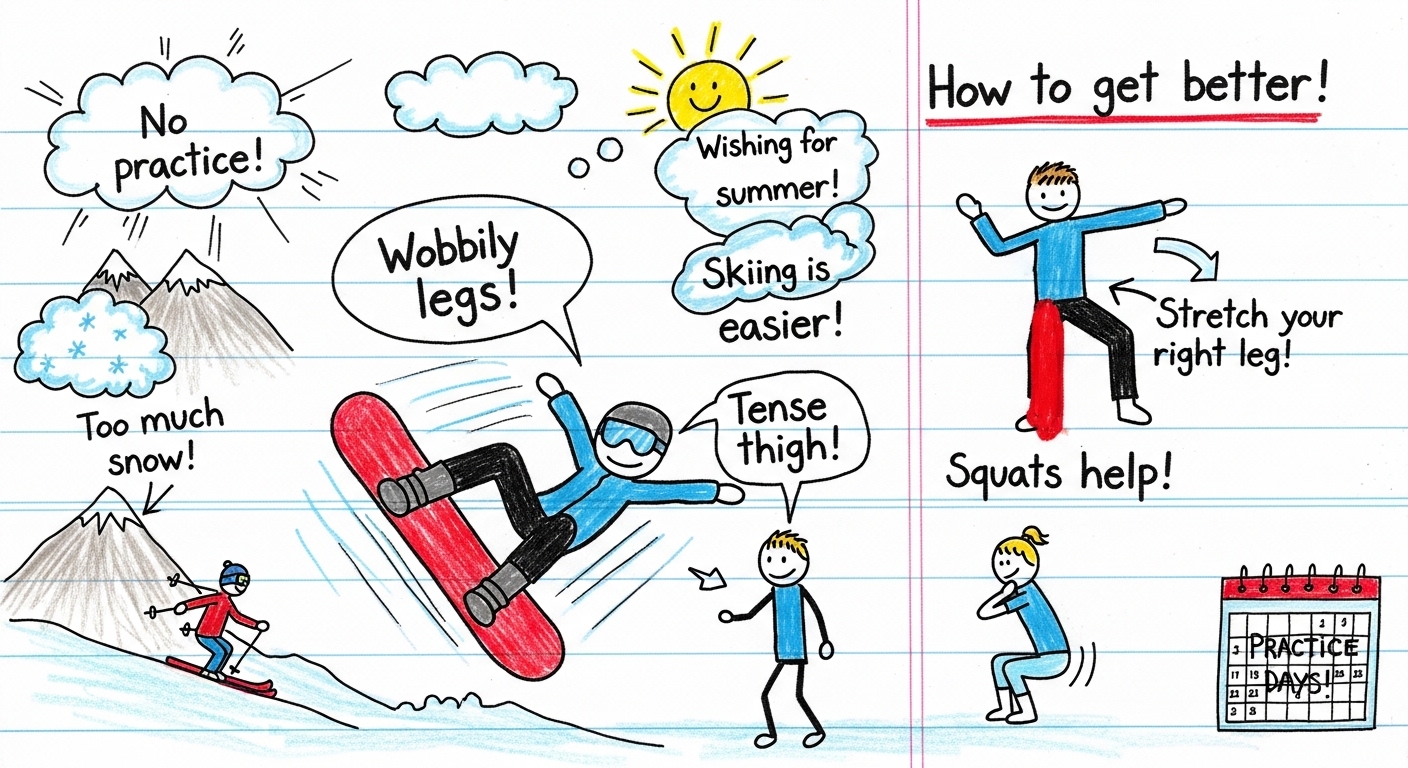
For three months, I came off the mountain with the same issue: my right quad was completely blown out. Left leg, fine. Right quad, destroyed.
I tried everything I was told to try. Torsion drills. Weight forward. More edge pressure.
Nothing changed.
Because I was solving the wrong problem.
Why Individual Differences Matter More Than Technique
Before we get into what changed, here’s the foundation.
Bone structure varies. Hip socket angle (acetabular version) and femoral neck angle differ between people. The same stance width and binding angle that creates perfect hip alignment for one rider can put another’s knee under stress every single turn.
Joint mobility varies. Ankle dorsiflexion range is one of the most significant variables in snowboarding. Research confirms that restricted ankle mobility directly limits hip flexion and knee mechanics (Fong et al., 2011). Two riders doing the exact same “press into your highback” move will get completely different results depending on how much ankle mobility they have.
Hip mobility varies. The range of internal and external hip rotation determines how much force a rider can process through the hip joint during a turn. A rider with limited hip mobility will compensate at the knee or lumbar spine—often without knowing it.
Thoracic rotation varies. How much the upper spine can rotate affects whether upper-lower body separation is even possible. Telling someone to “keep your upper body quiet” when their thoracic spine is stiff just loads the lumbar spine.
Movement patterns vary. Some people are wired to initiate movement from the extremities outward. Others initiate from the core and transfer to the limbs. Neither is wrong. They require different inputs to produce the same output.
What the Muscle Soreness Was Telling Me
The day things changed, my soreness pattern was completely different.
Instead of my right quad, I felt:
- Left peroneus longus (outer lower leg, front foot)
- Left biceps femoris (hamstring, front foot)
- Left gluteus maximus and medius (front foot hip)
- Right oblique (rear foot side, core)
Right quad: barely sore.
Read the pattern. Left foot input → right core output.
That’s a diagonal line through the body. Force entered through the front foot, traveled through the hip, and transferred to the opposite side of the core.
This is exactly what should happen in an efficient turn. The kinetic chain—ankle to knee to hip to core—stayed connected instead of being blocked at the knee.
What I Actually Did Differently
Two simple things.
On toeside turns: I let my front shin press against the tongue of the boot.
On heelside turns: I let my calf rest against the highback.
That’s it. No torsion drill. No conscious weight shift. Just contact.
Why Contact Works Better Than Conscious Torsion
Here’s where the science explains the feeling.
External vs. Internal Focus
Motor learning research has consistently shown that external focus of attention outperforms internal focus for movement efficiency and learning retention.
A meta-analysis of 73 studies with 1,824 participants found that focusing on external cues—something outside the body—produced significantly better performance and retention than focusing on body movements themselves (Chua et al., 2021).
Torsion is an internal focus. You’re thinking about how your feet move relative to each other. That kind of conscious control tends to make movement slower, stiffer, and less coordinated.
Pressing into the highback is closer to an external focus. You’re thinking about contact—is my calf touching it or not? The brain processes this differently, and the downstream movement tends to be more fluid and automatic.
Tactile Feedback and Motor Control
Research from Science Advances (2019) demonstrated that tactile input from skin contact serves as an auxiliary proprioceptive cue for motor control. The mechanical receptors in the skin send position and movement information to the central nervous system that complements muscle-based proprioception.
When you press your calf against the highback, you’re not just creating mechanical force. You’re giving your nervous system a reference point. The body uses that reference to organize movement upstream—hip, core, spine—without you having to think about each piece.
The Kinetic Chain
The foot-ankle-knee-hip-core connection is well established in biomechanics research. When any link in the chain is blocked, the system compensates. Usually somewhere painful.
Pressing into the highback keeps the ankle in a functional dorsiflexed position. That ankle position facilitates knee tracking. Knee tracking facilitates hip engagement. Hip engagement allows the core to receive and transfer force.
Block the chain at the knee—which is what “stopping with the quad” does—and none of this happens.
Why “Use Torsion” Works for Some Riders and Not Others
Movement initiation patterns differ between people.
Some riders are naturally distal initiators—they generate movement from the extremities (feet, hands) and transfer it inward. For these riders, consciously creating torsion at the foot makes sense. It matches how their nervous system naturally organizes movement.
Other riders are proximal initiators—they generate stability at the core and hip first, then transfer to the limbs. For these riders, trying to initiate movement from the feet disrupts the natural sequence. The input comes in the wrong place and the system doesn’t connect.
This isn’t a preference. It’s a wired-in movement pattern, likely influenced by bone structure, muscle attachment, and years of habitual movement.
If you’re a proximal initiator trying to execute a distal-initiation technique, you’ll work harder, get less output, and load the wrong structures. Your quad will burn. Your hip won’t engage.
The fix isn’t to practice torsion more. The fix is to find an input that matches how your system actually initiates movement.
For me, that input is contact.
The Role of Difficult Snow Conditions
The day this clicked was soft, afternoon snow. Bumpy, heavy, unpredictable.
That kind of snow is unforgiving of compensations. You can’t muscle through soft, chopped-up terrain with quad dominance. The snow absorbs the force and gives nothing back.
In those conditions, the body has to find a more efficient path. Mine found it through contact and hip engagement because that was the only thing that worked.
The snow didn’t make me better. It eliminated what wasn’t working.
Individual Sport, Individual Problem
Snowboarding is a solo sport. There’s no coach watching every turn. There’s no team providing external reference.
Instructors teach from their own body’s experience. If they initiate from the foot, they’ll teach foot initiation. If their hips naturally engage, they’ll assume everyone’s hips naturally engage.
When their cue doesn’t work for you, the default explanation is that you need more practice, more strength, or more commitment.
Sometimes that’s true.
But sometimes the cue is just wrong for your body.
The difference matters.
One Thing to Try
Next session, stop trying to create torsion.
Instead: let your front shin rest against the boot tongue on toeside turns. Let your calf contact the highback on heelside turns. Don’t force it. Just allow the contact.
See if the soreness pattern changes.
If your quad is still destroyed and your hip feels nothing, the kinetic chain is still blocked. That’s information.
If your hip, hamstring, or oblique starts showing up sore for the first time, the chain is connecting. That’s also information.
Your body is already tracking what’s working. You just have to know how to read it.
What This Is Not
This is not a universal technique guide.
This is one rider’s account of what changed, read through the lens of biomechanics and motor learning research.
Different body types need different inputs. The same contact cue that unlocked hip engagement for me might do nothing for someone with different mobility patterns or movement initiation tendencies.
The principle is universal: find the input that connects your kinetic chain without forcing conscious control of each link.
The specific input is individual.
Next session goal: reproduce the same diagonal soreness pattern on the opposite turn direction. If right hip and left oblique show up, the chain is working both ways.
Related
- Why Your Right Thigh Burns Out on the Mountain—And What It’s Actually Telling You
- Why the Left AdductWhy Your Right Thigh Burns Out on the Mountain—And What It’s Actually Telling Youor Gets Tight—and How It Limits Hip Mobility
- Why Only Your Right Thigh Burns Out Snowboarding—It’s Not a Strength Problem
コメント