
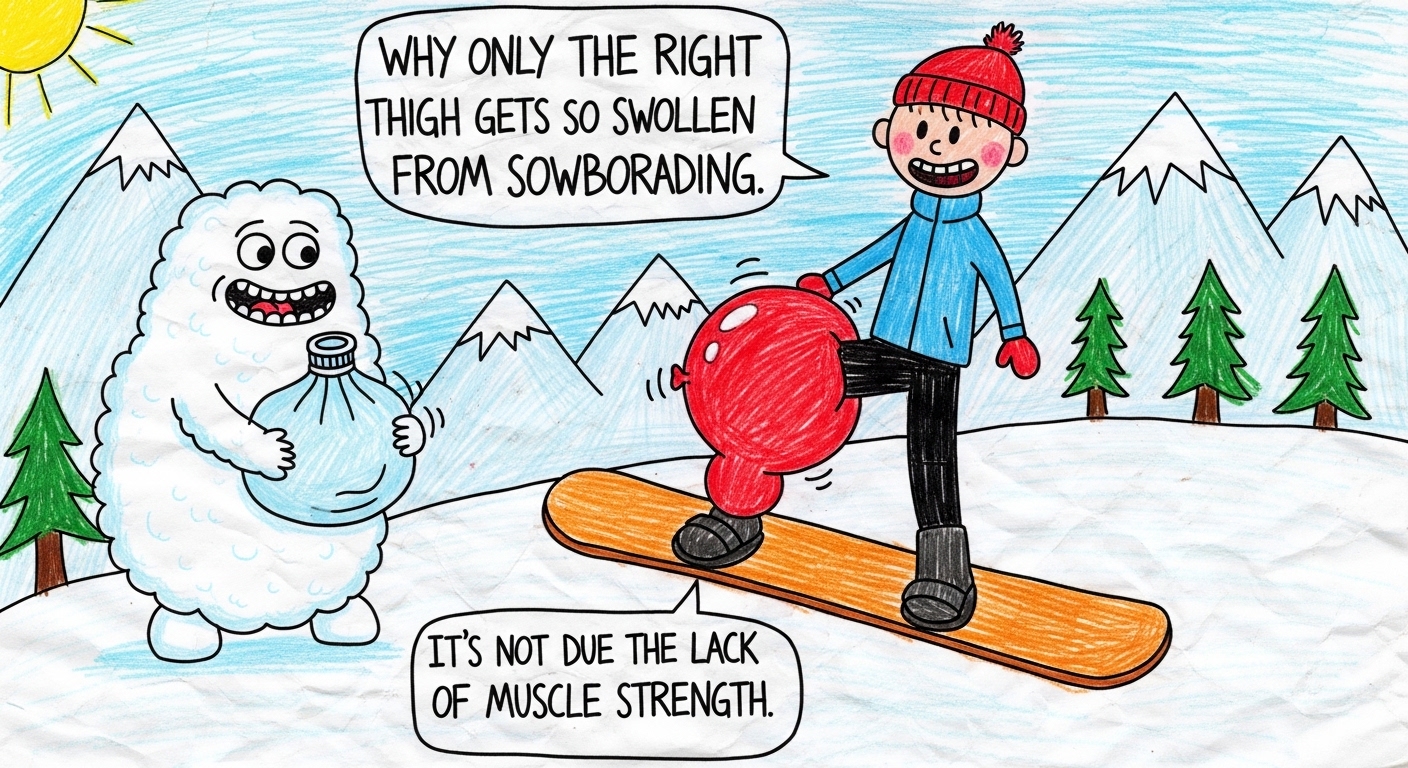
Right quad destroyed after every run. Left leg barely sore. Same pattern every session.
“Maybe I need to train harder.” “Maybe my left side is just weak.”
Neither of those turned out to be the problem.
The real cause was a movement chain error. And once I traced it back to the source, the whole thing made sense.
- It Started With One Question: Why Only the Right?
- I Thought It Was a Strength Problem
- The Turning Point: Releasing the Right Quad Changed Everything
- Why Releasing the Quad Freed Upper Body Rotation
- The Root Cause: I Couldn’t Load the Left Side
- The Full Chain: One Cause, One Long Effect
- What to Do About It
- Summary
- Related
It Started With One Question: Why Only the Right?
After sessions, my right quad was completely blown out. My left leg felt almost nothing.
At first I assumed it was normal. But the pattern never changed. The more I rode, the more my right side took everything.
This question—why only the right—turned out to be the right question to ask.
I Thought It Was a Strength Problem
My first hypothesis was simple.
“Train the left side more.” “Build more core stability.”
I did both. The soreness pattern didn’t change. My right quad still took all the load every session.
Then I thought it was a technique problem. “Get more on the front foot and it’ll fix itself.”
That didn’t work either. The tail still drifted at the end of turns. The right quad still burned.
Not strength. Not technique. Something else.
The Turning Point: Releasing the Right Quad Changed Everything
The shift came during post-session recovery.
I was foam rolling my right quad. On a whim, I rotated my upper body—and it moved freely. Noticeably more freely than before.
Until that moment, there had always been something catching in my right-side rotation. After releasing the quad, it was gone.
The problem wasn’t in my upper body. It was in my lower body the whole time.
Why Releasing the Quad Freed Upper Body Rotation
There’s a biomechanical explanation for this.
Muscles operate under a principle called reciprocal inhibition. When one muscle contracts strongly, its antagonist receives inhibitory signals through the nervous system. When the quadriceps are chronically overactivated, hamstring activation is suppressed.
Beyond that, quad overactivation tends to pull the pelvis into anterior tilt. A tilted, immobile pelvis restricts the thoracic and cervical spine above it. Research on kinetic chain function confirms that dysfunction at any link creates compensatory loading at adjacent segments—often at the extremities (PMC, 2024).
The right quad overactivation was blocking pelvic movement, which was blocking upper body rotation. The symptom was high in the chain. The cause was low.
The Root Cause: I Couldn’t Load the Left Side
Digging further, another pattern emerged.
My right knee naturally tracked inward during turns. My left knee didn’t. When I tried to shift weight onto my left foot, something felt unstable—like I couldn’t quite commit to it.
So my body defaulted to staying right. And when you stay right, you end up loading the outside edge of your right foot to hold position. That lateral loading pattern disrupts hip internal rotation and adduction. Without hip function, rotation stops. Without rotation, the right quad picks up the work of turning.
Research on ankle dorsiflexion confirms this connection: restrictions in foot and ankle mobility directly limit knee and hip mechanics further up the chain (Fong et al., 2011). Left foot and ankle restrictions were likely contributing to the inability to load the left side properly.
The Full Chain: One Cause, One Long Effect
When you map it out, it looks like this:
Can’t load left foot → Pelvis stays right → Hip mechanics shift → Right side takes load → Lateral weight on right foot → Right ankle locks → Hip rotation stops → Right quad processes the whole turn
These weren’t separate problems. They were one continuous chain. The burning right quad was just the last thing in the sequence—the most visible symptom of an error that started further up.
What to Do About It
The source of the chain is the inability to load the left side. That’s where the fix has to start.
Step 1: Release the Right Quad
Before anything else, reduce the overactivation that’s blocking everything upstream.
Foam roll or manually massage the right quad. Not hard—find the range that feels productive without creating more tension. Do this after sessions when the muscle is warm. Even a few minutes makes a measurable difference in pelvic mobility.
Step 2: Check Left Adductor Tightness
One reason the left side is hard to load: tight left adductors restrict how far the left knee can track outward, which limits hip external rotation and overall hip mobility.
Test: sit on the floor, press the soles of your feet together (butterfly position). If the left knee sits higher than the right, the left adductors are tighter. Post-session butterfly stretches, held for 30–60 seconds, help address this over time.
Step 3: Find the Left Foot Loading Point
The left side loading starts from the ground up.
Shift weight onto the inner heel of the left foot—roughly the line from the inner heel bone toward the ball of the foot under the big toe. From this position, the adductors engage naturally, the hip follows, and the chain activates from the bottom.
Before riding, stand still and practice feeling this contact point on the left foot. If the inner thigh engages slightly without you forcing it, the chain is connecting.
Step 4: Stop Trying to Make the Turn Happen
Overriding the turn with the rear foot is what created the quad dominance in the first place.
Motor learning research shows that external focus—directing attention to the outcome or environment—produces more efficient movement than internal focus on body mechanics (Chua et al., 2021). Instead of thinking about how your body should move, shift attention to how the board is responding. Let the turn happen rather than driving it.
This switch alone reduces rear-foot dominance significantly.
Summary
A burning right quad isn’t a strength deficit. It’s the last visible symptom in a movement chain that started breaking down much earlier.
The chain: Can’t load left → Pelvis stays right → Hip mechanics fail → Lateral loading → Ankle locks → Rotation stops → Right quad absorbs everything.
Fix the chain from the bottom. Release the right quad. Address left adductor tightness. Establish the left foot loading point. Stop forcing the turn.
The body isn’t broken. It’s compensating. Once you understand the compensation pattern, fixing it becomes straightforward.
Note: This article reflects personal experience combined with movement science principles. Individual results will vary based on body structure, mobility, and riding style.
Related
- Why Your Right Thigh Burns Out on the Mountain—And What It’s Actually Telling You
- Why the Left AdductWhy Your Right Thigh Burns Out on the Mountain—And What It’s Actually Telling Youor Gets Tight—and How It Limits Hip Mobility
- Why Only Your Right Thigh Burns Out Snowboarding—It’s Not a Strength Problem
コメント