Can’t load the left foot. Try to get on the front foot, but something feels unstable. So you stay right. The rear foot takes over. The right quad burns out.
I thought this was a technique problem for a long time.
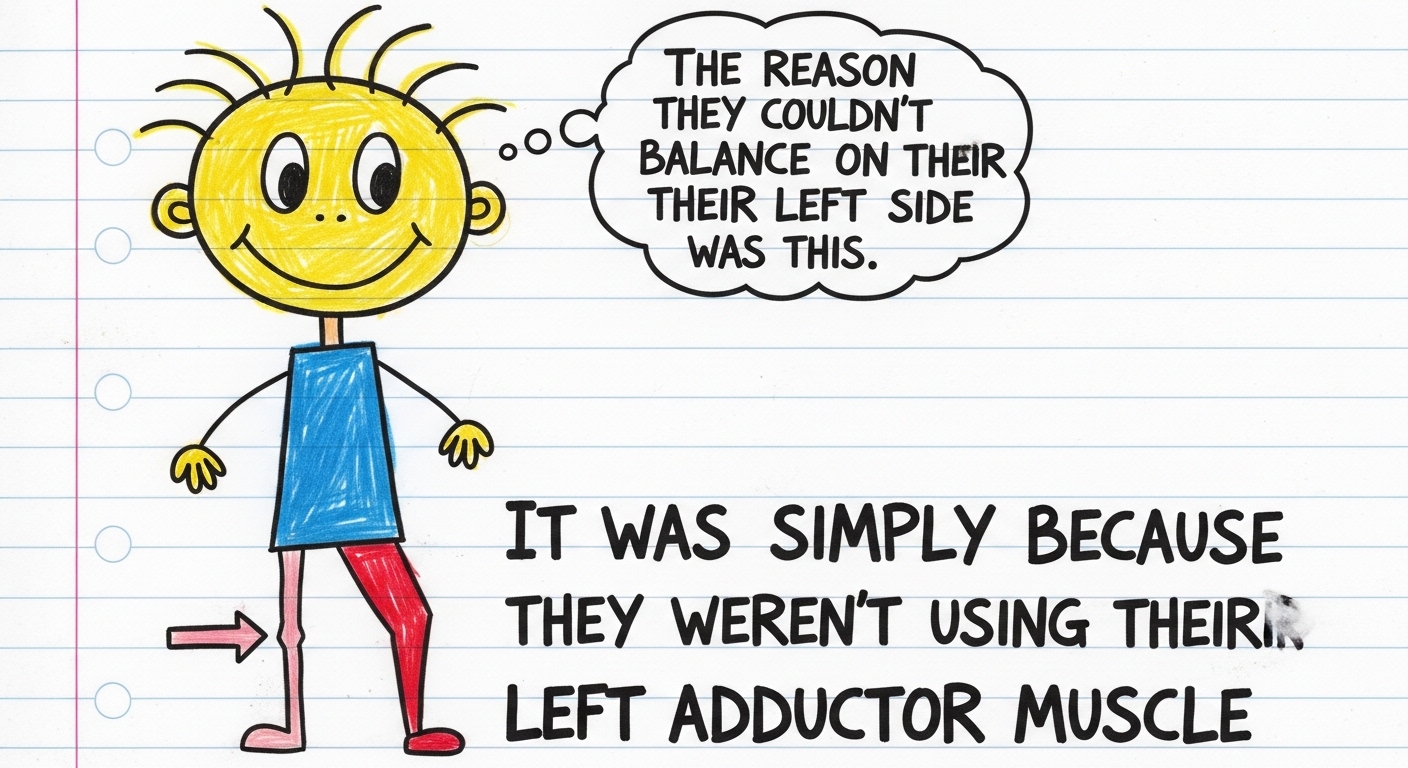
It wasn’t. The left adductor just wasn’t working.
The Feeling of “Can’t Get Left”
It started as a simple observation.
My right knee naturally tracked inward. My left knee didn’t do the same thing. Even just standing still, the left side felt different—the knee didn’t want to come in.
On the snow, the same pattern appeared. Left turns felt unstable. The contact felt thin. When I tried to load, something would slip.
There was always a feeling of not quite being on the left side.
Trying Harder Made It Worse
So I tried to consciously load the left foot more.
It made things worse.
The reason is simple: if the supporting muscle isn’t working, loading onto it just makes you wobble. The body defaults to the outside edge. You drift back right. The effort produces the opposite result.
It wasn’t a focus problem. It was a function problem.
The Left Adductor Wasn’t Working
This is where it clicked.
The left adductor group—the muscles along the inner thigh—weren’t activating properly. When these muscles work, the knee tracks inward, the hip stabilizes, and the body can stay centered over the inside edge.
When they don’t work, the knee drifts outward. Support disappears. Loading becomes unstable.
That’s why I couldn’t get left. Not technique. Not focus. The muscle wasn’t online.
Why the Adductor Stops Working
The adductors are easy to lose.
In daily life, there are almost no natural movements that require hip adduction. Without regular use, the neural pathway weakens. The muscle is still there—it just stops responding reliably.
In snowboarding, rear-foot dominant riding compounds this. When you consistently rely on the back foot, the front-side hip and adductor pathways get less and less input. Even when someone tells you to get on the front foot, the neural pathway for doing so has atrophied. The body can’t respond even when the mind is trying.
Tightness is another factor. When the adductor is shortened and stiff, it restricts how far the knee can track outward, limiting hip external rotation and overall hip mobility. Both reduced neural activation and physical tightness can produce the same symptom: a left side that won’t load properly.
A simple check: sit on the floor and press the soles of your feet together (butterfly position). If the left knee sits noticeably higher than the right, the left adductor is either tight or underactivated—or both.
What Happens When You Can’t Load Left
This is the part that matters most.
When the left side doesn’t load, a chain reaction follows:
Pelvis stays right → Body has to support from the right → Lateral loading on right foot → Right ankle locks → Hip rotation stops → Right quad processes the entire turn
Research on kinetic chain function confirms that dysfunction at any link creates compensatory loading downstream—typically accumulating at the end of the chain (PMC, 2024). A left adductor that isn’t working starts a chain that ends with the right quad taking everything.
The right quad burning out is just the last symptom. The origin is the left adductor.
Loading the Left Side Is a Result, Not an Action
This was the key realization.
Loading the left side isn’t something you do consciously. It’s what happens when the adductor is working.
You don’t try to load. You create the conditions for loading to happen naturally.
Motor learning research supports this distinction. External focus—directing attention to outcomes rather than body mechanics—consistently produces more efficient movement than internal focus (Chua et al., 2021). “Try to get on the left foot” is internal focus. “Create the conditions” is closer to external focus.
Trying to load → destabilizes
Creating the conditions → loading happens on its own
That shift changed everything.
What Actually Changed
The approach was simple.
Instead of trying to load the left foot, I focused on activating the left inner thigh—not squeezing, just a light sense of the muscle being present. While standing still. Before riding.
The entry point: shift weight onto the inner heel of the left foot, along the line toward the ball of the foot under the big toe. From this contact point, the adductor activates naturally without forcing it.
When this worked, the left knee came in on its own. The feeling of standing changed. The sense of being on the left side appeared without effort.
On snow, the entry into left turns changed. Dependence on the right decreased. Drift decreased. None of it required forcing.
Three Common Mistakes
① Trying to strengthen the adductor
Strength isn’t the issue in most cases. The adductor needs to be activated and connected, not just made bigger. Leg adduction exercises in a gym context don’t automatically translate to adductor function during dynamic snowboard movement.
② Squeezing hard
When people focus on the adductor, they tend to squeeze. Hard squeezing creates overactivation, which can restrict hip mobility and produce the opposite of the intended effect. A light response is what’s needed—not a forceful contraction.
③ Forcing left-side loading
This is the most common mistake and the most disruptive. Forcing weight onto a side that isn’t supported yet just increases instability. The correct order is: get the adductor working first, then loading happens as a result.
Summary
The reason I couldn’t load the left side was that the left adductor wasn’t working.
From there: the pelvis stays right, lateral loading builds, the ankle locks, rotation stops, and the right quad takes the whole turn. It’s one chain.
Not talent. Not technique. A functional state.
When the adductor starts working, loading the left side stops being an effort and starts being what happens.
Nothing is broken. The system is just compensating. Fix the compensation, and the riding changes.
Note: This article reflects personal experience combined with movement science principles. Individual results will vary based on body structure, mobility, and riding style.
Related
- Why Your Right Thigh Burns Out on the Mountain—And What It’s Actually Telling You
- Why the Left AdductWhy Your Right Thigh Burns Out on the Mountain—And What It’s Actually Telling Youor Gets Tight—and How It Limits Hip Mobility
- Why Only Your Right Thigh Burns Out Snowboarding—It’s Not a Strength Problem
コメント