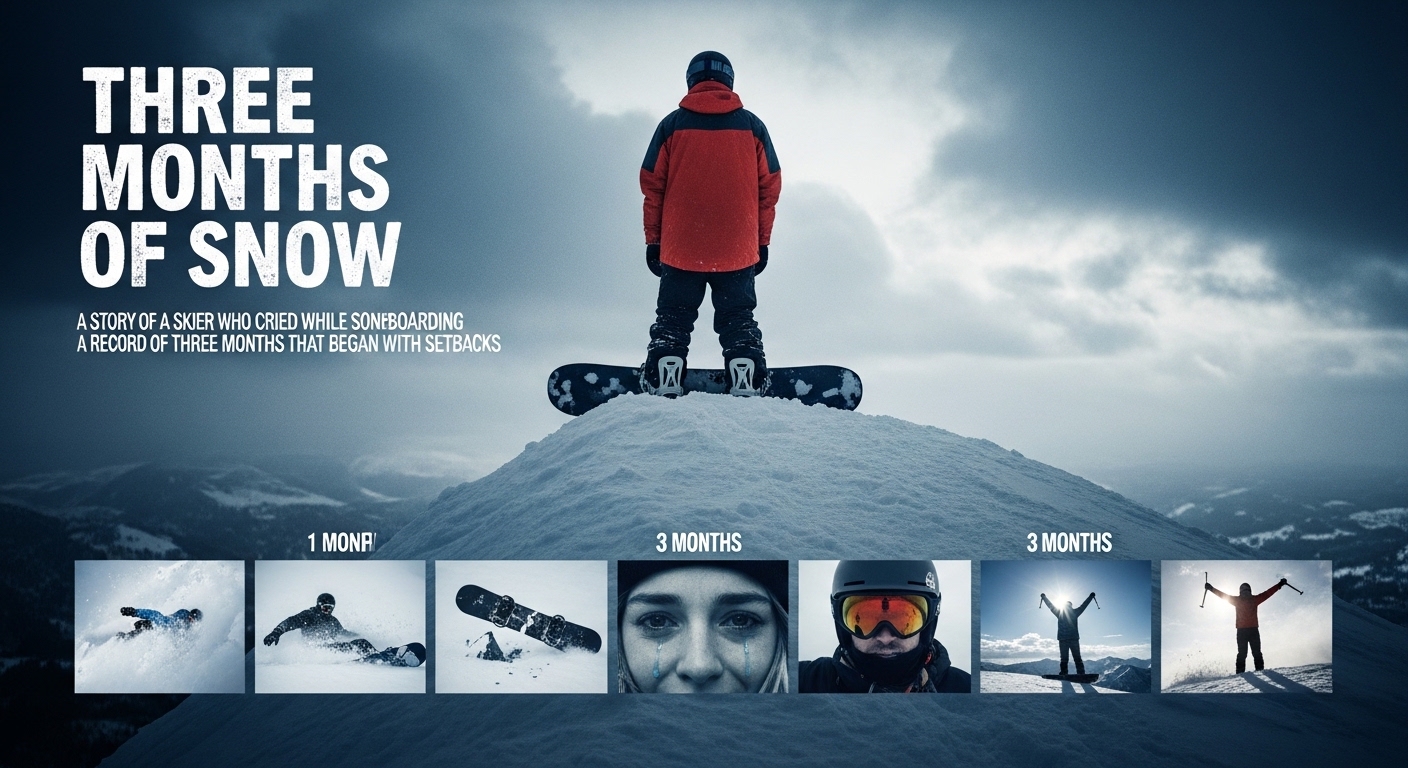
The first time I tried snowboarding, I looked down from the top of the mountain and the slope looked like a wall.
It probably wasn’t that steep. But in that moment, it looked vertical.
I fell. Got up. Fell again.
By the time I reached the bottom, I was crying.
I returned the rental board and didn’t touch a snowboard again for years.
I Grew Up on Skis
I started skiing when I was young. Snow wasn’t scary. Moving my body on a slope wasn’t scary. So when the opportunity came to try snowboarding, I assumed I’d figure it out.
I was wrong.
Skiing and snowboarding are fundamentally different sports. Different body orientation. Different weight distribution. Different edge mechanics. For someone who spent years moving two independent skis, riding one board sideways is almost a complete reset.
Worse, the ski experience created bad habits. My body kept trying to do ski things. And ski things on a snowboard just make you fall differently.
2025: Back on Skis
After years away from any snow sport, I went back to skiing in January 2025.
The mountain felt familiar. My body remembered. I was fine on skis almost immediately.
But something else happened that day.
Friends I came with were snowboarding. Moving down the mountain easily. Looking effortless and, honestly, much cooler than skiing.
The feeling came back. The same feeling I had before the mountain that looked like a wall.
I wanted to try again.
The Mentor
One of those friends had been riding for twenty years.
He used to hit jumps. Now he focuses on carving—deep, technical, methodical carving. He’s the kind of rider who has developed a theory of how the sport works, not just muscle memory.
He became my mentor.
“Want to give it a shot?”
January 2026. Back on a snowboard for the first time since the day I cried on a mountain. Years had passed.
This Time Was Different
I expected to struggle the same way.
I didn’t.
Part of it was equipment. Modern hybrid camber boards are dramatically different from what I rode that first day. The board actually wants to work with you rather than against you.
Part of it was having someone who knew how to explain things.
By my second session, I could ride. Not well. But I was actually snowboarding.
That was the moment I decided: I’m going to figure this out completely.
But the Walls Came
As I improved, new problems appeared.
Right quad burning out after every run. Can’t load the left side. Edge won’t hold on hard snow. Turns drifting in the back half.
I asked my mentor. He explained through feel.
“Cross your hips.” “Push through the front foot.” “Flexibility matters.”
All of it made sense as language. None of it translated into movement I could replicate.
He had twenty years of physical knowledge compressed into those phrases. The phrases were accurate. But I didn’t have the physical reference point to receive them.
Feeling-based instruction couldn’t reach me.
So I Started Dissecting
If I can’t understand through feel, I need to understand through structure.
Anatomy. Biomechanics. Motor learning. Movement science.
I started treating my own body as a research subject and decoding what my mentor’s phrases actually meant at the mechanical level.
“Cross your hips” → thoracic rotation and pelvis stability working together.
“Push through the front foot” → weight transfer and adductor activation sequence.
“Flexibility matters” → not static flexibility, but dynamic range of motion under load.
Every phrase turned out to be accurate. I just needed the structural explanation underneath it.
And then I noticed something else. Watch enough snowboarders and they all look like they’re doing the same thing. But they’re not. Their bodies are different. Their weight distribution is different. Their joint mobility is different. Their movement initiation patterns are different.
The instruction that works for one person doesn’t automatically transfer to another. The movement looks the same from the outside.
The mechanics producing it are not.
What This Blog Is
I started snowboarding in January 2026. Three months in. Complete beginner.
My mentor has twenty years of experience. This blog is the process of translating his felt knowledge into structural language—anatomy, movement science, biomechanics—so that it can actually be applied by someone who doesn’t already have the physical reference.
No snowboard school. No coach certification. Just data, experience, and a willingness to be wrong and keep investigating.
Why take this approach?
Motor learning research suggests that identical instruction can produce different outcomes depending on the learner’s physical characteristics—bone structure, muscle function, joint mobility, weight distribution patterns. What a skilled instructor has internalized as feel is built on their specific body. It doesn’t automatically apply to a different body.
“You just need more practice” and “you don’t have the feel for it yet” are often the end of the conversation when someone isn’t improving. This blog is an attempt to go further than that.
If you’ve been riding for a while and something isn’t connecting—if the instruction makes sense but doesn’t translate into your body—this might be useful for you.
That’s who I’m writing for.
Related
- Why Your Right Thigh Burns Out on the Mountain—And What It’s Actually Telling You
- Why the Left AdductWhy Your Right Thigh Burns Out on the Mountain—And What It’s Actually Telling Youor Gets Tight—and How It Limits Hip Mobility
- Why Only Your Right Thigh Burns Out Snowboarding—It’s Not a Strength Problem
コメント